
Characterization of making ethical decisions in neonatal care units by pediatricians and neonatologists
Keywords:
Recién Nacido, Ética Clínica, Cuidado Intensivo Neonatal, Cuidado Terminal, Neonatología, Newborn, Infant, Clinical Ethics, Neonatal Intensive Care, Terminal Care, Physician's Practice Patterns, Neonatology, Recém-Nascido, Terapia Intensiva.
Abstract
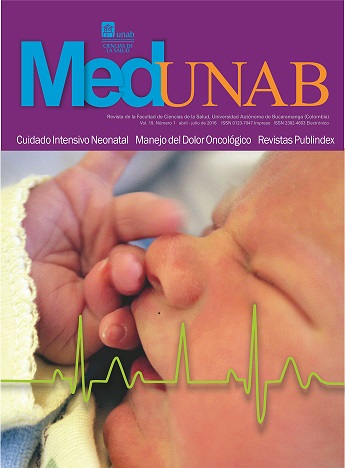
The survival of critically ill neonates has increased, which has led to professional caregivers of these babies to face ethical decisions about it. This paper outlines the aim of characterizing ethical situations that caregivers face, the criterion they use and how decisions on ethical dilemmas are taken by Pediatricians and Neonatologists. Methodology: A cross-sectional study was performed. 87 neonatologists and/or Pediatricians, who work in neonatal care units in Chia and Bogota between October 1 of 2014 and January 31 of 2015, were invited to participate and answer a characterization survey voluntarily, but only 45 professionals (51.7%) agreed to take part in it. An exploratory data analysis was performed by using descriptive statistics. Results: Professionals who answered the survey, 100.0% of them has faced ethical problems, 60.0% of them has received some training in bioethics, 33.0% relies on ethics committee, 98.0% has a viability limit to start reanimating and 93.0% has limited the therapeutic effort; 98.0% includes parents in decisions and registers the decision in the medical record. Conclusions: Ethical conflicts in the neonatal care unit are frequent. Most professionals have training and an ethics committee for decision-making. Among the specialists there are heterogeneous views on certain ethical problems in neonatal care units. [Agudelo-Pérez SI, MaldonadoCalderón MJ, Pinzón-Flórez C, Pérez-Barreto C, Mazzantidi-Ruggiero M. Characterization of making ethical decisions in neonatal care units by pediatricians and neonatologists. MedUNAB 2016; 19(1): 9-17]
How to Cite
1.
Agudelo-Pérez SI, Maldonado-Calderón MJ, Pinzón-Flórez C, Pérez-Barreto C, Mazzanti-Di Ruggiero M. Characterization of making ethical decisions in neonatal care units by pediatricians and neonatologists. MedUNAB [Internet]. 2016 Apr. 25 [cited 2026 Mar. 9];19(1):9-17. Available from: https://revistasunabeduco.biteca.online/index.php/medunab/article/view/2339
Downloads
Download data is not yet available.
Published
2016-04-25
Section
Original Article
| Article metrics | |
|---|---|
| Abstract views | |
| Galley vies | |
| PDF Views | |
| HTML views | |
| Other views | |
Escanea para compartir