
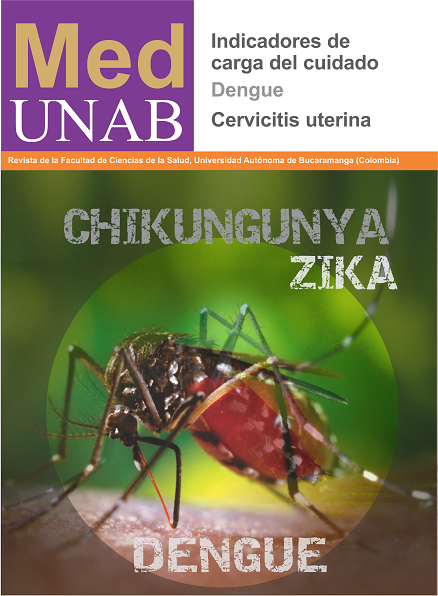
Behavior of simple dengue during the last four years in Santander, Colombia
Abstract
Introduction: Transmission and incidence of dengue virus have greatly increased during the last three decades which is the reason why it is currently considered the most emergent infectious disease that causes morbidity and mortality around the world. Objective: Observe simple dengue behavior in the last four years in Santander, Colombia. Method: An analytical study based on secondary data of simple dengue in Santander was performed between the years 2007 and 2015. The weekly epidemiological incidence was calculated and endemic channels between the years of 2012 and 2015 were built using logarithm base 10 with geometric mean and confidence intervals of 95%. The investigation was classified as non-risky according to Law 8430 of 1993, Republic of Colombia. Results: The National Service of Public Health Surveillance (SIVIGILA) reported 26.849 cases of simple dengue in Santander between the years of 2007 and 2015. The cutoff points (success, security, risk, and epidemic) vary in different zones, with significant statistically differences of 4.2 (in 2007), 2.9 (in 2010), and 8.1 (between 2013 and 2014) for each 100.000 inhabitants. Conclusions: The endemic channels of dengue must be taken into account as well as the impact of calculated incidence for monitoring the disease. According to the secular trend, every 3 to 4 years, there is a peak incidence. It is possible that in 2016 a new and bigger peak incidence of dengue will take place in Santander. It is therefore necessary to consider strategies and immediate measures to control this disease. [Serrano-Gómez SE, De-Montijo C, Rey-Serrano JJ. Behavior of simple dengue during the last four years in Santander, Colombia. MedUNAB 2015; 18(2):107-115]
Downloads
| Article metrics | |
|---|---|
| Abstract views | |
| Galley vies | |
| PDF Views | |
| HTML views | |
| Other views | |